
January to March Book Roundup
30th March 2026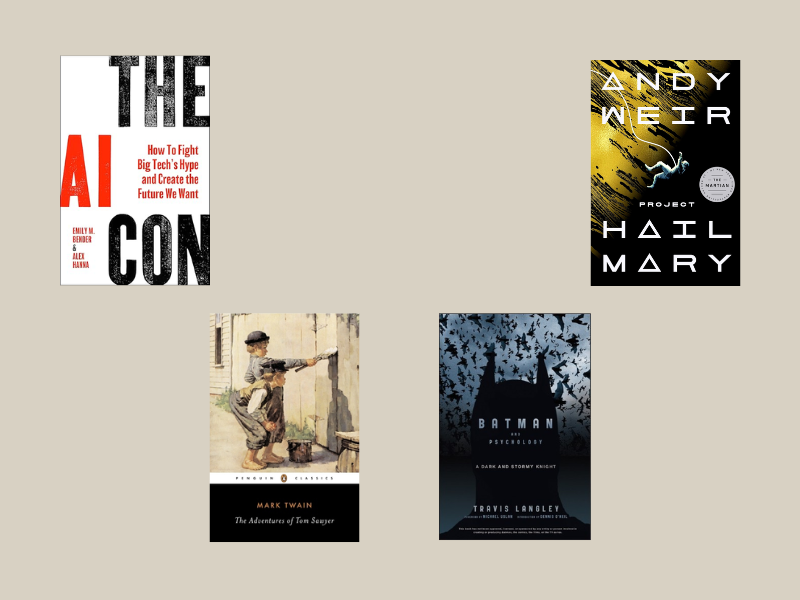
In 2026, I decided that I was only going to read 10 books this year, and most of them would be from my over 500-page list. A lot of them are actually political memoirs, and with the current political climate, I guess I will go read them. I mean, I haven’t cleared them out of my TBR for some reason, right? But that doesn’t mean I need to start with them. These are the books I started with. Yes, I fell into a sort of reading slump, but I was also in India and preparing for a cloud certificate.
The AI Con: How to Fight Big Tech’s Hype and Create the Future We Want – Exposing Surveillance Capitalism and Artificial Intelligence Myths in Information Technology Today by Emily M. Bender and Alex Hanna
As someone who is job searching and my field is only hiring AI engineers, I was immediately interested when I saw this in the library. But then I went to India and could only find the audiobook version on Spotify and Libby. This is a book I would want to revisit in paperback form. But anyway, in this book, the authors, with a linguistic and social science background, discuss how AI came to be, the previous AI hype cycles, and how the promise of AI is being used to destabilise the workforce and line rich people’s pockets. I have been reading about the ethics of AI and technology in general for a while, so some of this wasn’t new information, like the biases of the models and the blatant use of copyrighted material.
There was new information, such as how AI is being integrated into systems based on its potential and how it is constantly underperforming. They hope to plug existing shortfalls in social services with AI, but then the people promoting this would want “real” doctors, lawyers, nurses, and teachers. (Also, true). I found it interesting that AI-generated code is a security risk. I knew about the environmental costs of AI, but I was unaware of the scale of it, like the growth of AI is going to accelerate climate change, as the biggest companies in the world are tech. A grave statistic is that Google failed to meet its goals for a net-zero carbon future and saw a 48% increase in greenhouse gas emissions from AI use! That is ridiculous, as someone tired of AI being forced into every app. It finally made me delete and block ChatGPT. I mostly used it to create schedules or optimise my routines and related stuff. But I used to manage fine without it; it just took more time, which I have plenty of.
Batman and Psychology: A Dark and Stormy Knight by Travis Langley
I started this book at the beginning of the year and finally finished it after two months. I normally read before bed, but I’ve been so exhausted that I’ve only managed to read a page before falling asleep. My sister got me this book for my birthday, because I wanted to read it for over 10 years now. I always found that Batman is a complex character, so it was interesting reading an analysis of the character from a psychological perspective. The book goes into depth on his origin story, his interpersonal relationships, his motivations, fears, and, of course, his rogues’ gallery. The source material analysed is also quite rich and diverse, as it includes comics, movies, and TV shows.
The story of Batman and me is quite long, and I don’t think it belongs here. I will write it up at some point because thinking about it is making me excited. But I am not as into Batman as I used to be. So, I am always surprised by how much knowledge I have retained or the joy I get from Batman. Like most of the source material covered, I had read or was familiar with somehow, even though I haven’t picked up a comic book since December 2017. It was funny because, when discussing Batman’s avoidant tendencies in relationships, the example given was one I had read and had the same thought as the author did while reading it!
I think the best part of the book was when it discussed the impact a character like Batman can have on his community and in real life. The book mentioned how Batman inspired people to seek out help or to be more hopeful. Which I think was why I was drawn to Batman in the first place: his persistence, his never-giving-up. It made me feel hopeful and reminded me of how much joy I used to get from reading Batman comics, watching the movies or TV shows. I did enjoy this book and would recommend it, but I am weird. I used to listen to a podcast where a psychologist would analyse each Batman: The Animated Series episode while I did my maths homework.
Now I know what you are probably wondering. “Is Batman crazy?” The answer is “Apparently not in his world.”
Project Hail Mary by Andy Weir
I had this book on my TBR for a while, but I decided to read it since the movie just came out. I am going to watch the movie, but I I started the book first so choose to finish it before. I don’t know how much is a spoiler, but basically, our hero, Ryland Grace, wakes up with memory loss on a spaceship, the sole survivor of a mission to save the planet. We follow him in the past and present as memories come to him, and he tries to piece together what happened and what he needs to do. The book is written in first-person narrative and is very exposition-heavy because there is a lot of science to explain. I have a science degree and had forgotten a lot, so I was glad of it. But as the character works as a teacher, it seems natural because he doesn’t automatically assume people know what he’s talking about and is able to break down complex ideas into bite-sized chunks, which a lot of scientists struggle with. (Speaking from personal experience).
The book had my full attention while reading it, and it feels like we are constantly accelerating. However, around the ending of the book it loses its pacing. I felt it had a false ending. At that point, it just felt like a complication for the sake of it, but from what we learned about Ryland, it was needed for his character, as up to that point he was going through the motions, whereas this obstacle forced him to decide with real stakes. I thoroughly enjoyed the book and recommend it to anyone who enjoys science fiction or thrillers.
The adventures of Tom Sawyer by Mark Twain
I started this book not because of a sudden urge to read classics, but because I am trying to get through the Booker Prize books of 2024. One of them is James by Percival Everett, which is based on this series. So, I should take this opportunity to read this book. I was reading between sets at the gym, so it took me forever to finish! Mostly because I used to read while doing cardio, and on my new schedule, I haven’t been doing that. In this book, we follow 10-year-old Tom Sawyer on his adventures in St. Louis. Twain’s intention with the book was to remind adults of their childhood. I think he achieved that. A lot of the stuff Tom did, and his thought process was similar to how kids operate. At least from what I remember of my childhood and the games we played. That was my only thought; otherwise, it was fine the racism that existed in the time period is there, especially with the N-word usage. I will continue reading the adventures of Huckleberry Finn. He is introduced in this book, and I am really interested in what he gets up to. Maybe next month.
Until next Time!