July August Books Roundup
30th August 2026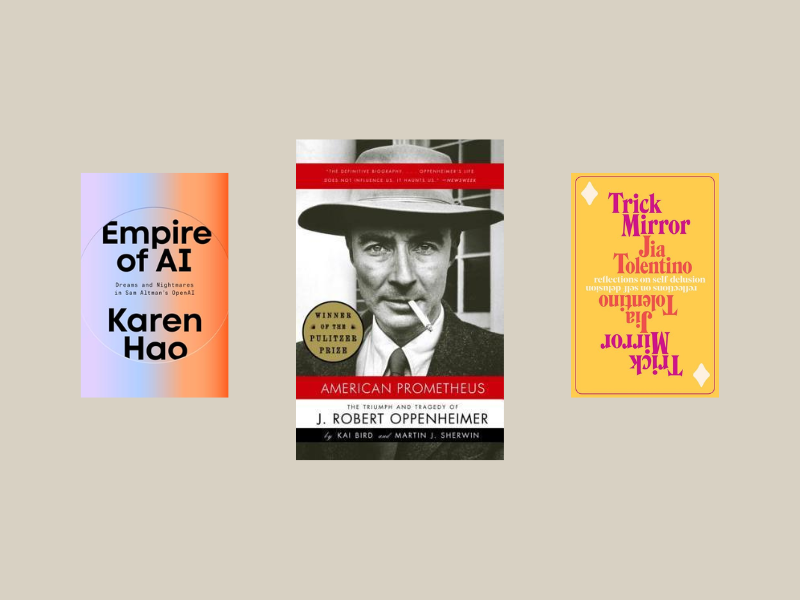
I am still trying to get rid of some of the books that are on the longer side but it has been a mission, the book order can be thwarted by how much reading I plan to do which happened these two months. Anyway these are the books that I read.
American Prometheus: The Triumph and Tragedy of J. Robert Oppenheimer by Kai Bird and Martin J. Sherwin
After I watched the 2023 movie Oppenheimer in the theatre (I did Barbieheimer), I naturally wanted to read the biography it’s based on. The book had a lot of reservations, and when it was finally my turn to read it at the library, I had to go. So, the time to read it was now. American Prometheus: The Life and Story of J. Robert Oppenheimer is a deep, deep look into the life of the father of the atomic bomb. We follow his life from birth all the way to death. Oppenheimer was born in 1903 to German Jewish parents in America. The book is thoroughly researched and took 20 years to write. There are countless resources, from interviews to videos to unclassified FBI documents. I don’t believe you would want to pick up another Oppenheimer biography after reading this one. It was really dense, at 600 pages, with a really small font. But it almost felt like watching a documentary, given how it was written.
Oppenheimer was a key figure in the development of quantum physics, and it was cool to see how many famous scientists he was bumping heads with. Like Rutherford, Einstein, Bohr, Pauli, etc. I felt the movie, with so many famous actors, was true to this, with you watching it being like, “Is that President Grant?” (Look, I know Tom Goldyn, descendant of the G in MGM, is more than Fitz, but come on). I could ramble endlessly about my thoughts on the book, or I could do a book vs. movie comparison. One thing is, I felt the movie kind of made light of the communism angle; it waved off communism as “these are high society people who support communism because it’s weird and quirky with their head in the clouds”. But it downplays that these people lived through the great depression, and so their policies were directly impacted by it. There are different ways to go forward, considering how many people, especially youth, felt betrayed. I guess we also feel that way about capitalism. We learn that Robert was charismatic, made friends easily, but was also troubled by personal demons. He wasn’t a good father from the sound of it. I think the man has done a lot in physics, such as proposing the theory of black holes, but his shining moment was the development of the atomic bomb.
Throughout the book, we are constantly thinking of “if you can, should you?” Like, I get why this group of people were motivated to work on the atomic bomb. Oppenheimer was Jewish, had family he had to help leave Nazi Germany, and had lived in Germany and had seen the rise of antisemitism in the country that led to Nazi Germany. He was also aware of how advanced physics was in Germany, so there was always going to be a race to build the atomic bomb; that part was inevitable. But should it have been used in Japan, a country that was not developing nuclear weapons and where, in the process of surrendering, that question is more complicated. There is a lot of politics here, and in this book, we learn about the differing viewpoints, but it leaves it to us to decide how we should feel about it. The book also covers the arms race with the Soviet Union that Oppenheimer wanted to prevent, and how they wanted the UN to monitor nuclear weapons, which sounds noble and his trial, which is the focus of the movie.
There are three things I want to explore more. Oppenheimer was really interested in the philosophy of the Bhagavad Gita. As a Hindu, I read the Gita in 2018, so it has been a while, and I want to compare my views and what I get out of it with his perspective. The second is to rewatch the movie and compare it to the book. The third is McCarthyism. I know the term, but not what it means. It made me remember that back in the day, when I didn’t know something, I would read a Wikipedia article about the topic end to end, and then I would be in endless Wikipedia articles. But I haven’t done that in a long time. So, I am going to learn about it that way. But yeah, good book, interesting for world war historians and nuclear physicists. He is a truly fascinating man with varied interests, and the science he was good at is not a way you could have a career in academia nowadays.
Trick Mirror: Reflections on Self-Delusion by Jia Tolentino
The Guardian called it bold and playful, but I would call it basic and derivative, maybe even dated. This book was on my TBR, I think, due to the hype and praise, and I started reading it at the Gym because a series of essays seemed like an easy read there. Then I had to take a break from the Gym, so I stopped reading, but it was due soon, so I quickly finished it, and it was over. I have read books by Internet personalities and writers in the past, such as Pure Innocent Fun by Ira Madison III and I Don’t Want to Die Poor by Michael Arceneaux. But this book was probably the weakest one, and I wasn’t a fan of the others that much either!
This book is a series of essays by New Yorker writer Jia Tolentino, who reflects on growing up as a millennial woman in the age of the internet. Although this book is well written, I found it somewhat lacking, as it just rehashed others’ thoughts on popular internet topics, and if you were even a little online between 2012 and 2018, there is nothing new here! The topics have been talked to death, the conclusions made are nothing you haven’t heard before, and even the personal anecdotes felt weirdly impersonal. As this was written in 2018, it also feels dated as we are in a new Trump Presidency and the internet has moved on. It leaves this book in a precarious place, because who would go for it if not the people who are already really chronically online?
I think my biggest gripe with the book, when I compared it to the other books I have read in the genre, is that I felt like anyone could’ve written it. With Pure Innocent Fun and I don’t want to die poor, both of those books felt personal. The essays on the pop culture they critiqued were unique, and even if some of them lacked depth, they still felt fresh. That sort of spark was missing in the book. So it was another book I should have skipped.
Empire of AI: Dreams and Nightmares in Sam Altman’s OpenAI by Karen Hao
This was probably my most anticipated book of the year; I was actually listening to it at the beginning of the year while on my runs. But I felt I wasn’t paying attention and was running slower than if I had listened to music instead. So then I reserved the book at my local library, which had 150 reserves. Of course, the book came when I was the busiest I have ever been! This month, I am working 60-hour weeks as I have taken over my parents’ shop. But would I let that stop me from finishing the book? Obviously not. If you, like me, have only been feeling indifferent to everything, well, this book will make you feel rage and sadness. There were times when I had to put the book down because I was fuming or had to cry. Sometimes both. Empire of AI, by Karen Hao, follows the rise of OpenAI, the company behind ChatGPT, from its nonprofit conception as a way for Elon Musk to safeguard against total human annihilation by robots to the company that is still betting on you believing Gen AI is just a few months away.
Karen Hao has been following the company since 2019. She starts the book by making the argument that Tech companies are modern-day empires that take resources and labour from the Global South to profit themselves and themselves only. She builds on this argument by tracing the rise of AI, the origins of Sam Altman and OpenAI, the problems with data centres, the resources mined in Chile, and the exploitation of people in Kenya and Venezuela for data moderation. When you finish the book, there is no doubt that we are living in an empire, the Empire of AI.
As someone who studied data science, I have always been drawn to books that focus on the humanities of technology. There are a lot of books on this topic, so I was worried this book would just be rehashing them. Instead, it brings a lot of new information to the table and, for the people being exploited by companies like OpenAI, it puts their stories front and centre. I was shocked to learn about the labour conditions of the people behind data labelling and content moderation for tech companies. The companies are taking advantage of these people’s desperation, and the work given is something out of a Black Mirror episode. Or that we don’t actually know how much water data centres use because that information is hidden, but that isn’t stopping companies from building data centres in places prone to droughts. Droughts! What shocked me was that data centres globally could use as much electricity as the whole of India by 2030, the world’s third-largest energy consumer! We truly are living in a dystopia.
I also found it interesting how the for-profit nature of research in the field has shifted the focus areas. Like, we could try to cure cancer with AI or find new antibiotics with machine learning, but instead, the resources and talent are going towards this, making ChatGPT 5 smarter and faster. It also shows how far white male privilege will get you, because how else would Sam Altman get a $1billion from Microsoft without it? It also talks about how we keep being told that technology or progress is inevitable, but is it really? OpenAI and Anthropic were trying to be leaders in AI safety by getting there the fastest, but how is that safe?
I never liked the big players in this company, but I wish I had brought this book so I could underline and highlight some of the truly delusional things these people say. Sam Altman believes he is this generation’s Oppenheimer! Oppenheimer was a proponent of open science, which is the opposite of how Sam Altman operates.
Overall, the book is thoroughly researched and really well written, and I don’t think it is overtechnical or overly simplified. As someone who loves reading about shady businesses and their shady practices, this was up my alley. But if you want to know more about OpenAI and how LLMs have taken over, this is a good book to read. I don’t know OpenAI’s future, but I do know who I want to write about it!
Until next Time!